
Chapter Three
The Building (Tent of Meeting)
The Command:
Ex.26:1 Make the tabernacle with ten curtains of finely twisted linen and blue, purple and scarlet yarn, with cherubim worked into them by a skilled craftsman.
Ex. 26:2 All the curtains are to be the same size -- twenty-eight cubits long and four cubits wide.
Ex. 26:3 Join five of the curtains together, and do the same with the other five.
Ex. 26:4 Make loops of blue material along the edge of the end curtain in one set, and do the same with the end curtain in the other set.
Ex. 26:5 Make fifty loops on one curtain and fifty loops on the end curtain of the other set, with the loops opposite each other.
Ex. 26:6 Then make fifty gold clasps and use them to fasten the curtains together so that the tabernacle is a unit.
Ex. 26:7 Make curtains of goat hair for the tent over the tabernacle-- eleven altogether.
Ex. 26:8 All eleven curtains are to be the same size-- thirty cubits long and four cubits wide.
Ex. 26:9 Join five of the curtains together into one set and the other six into another set. Fold the sixth curtain double at the front of the tent.
Ex. 26:10 Make fifty loops along the edge of the end curtain in one set and also along the edge of the end curtain in the other set.
Ex. 26:11 Then make fifty bronze clasps and put them in the loops to fasten the tent together as a unit.
Ex. 26:12 As for the additional length of the tent curtains, the half curtain that is left over is to hang down at the rear of the tabernacle.
Ex. 26:13 The tent curtains will be a cubit longer on both sides; what is left will hang over the sides of the tabernacle so as to cover it.
Ex. 26:14 Make for the tent a covering of ram skins dyed red, and over that a covering of hides of sea cows.
Ex. 26:15 Make upright frames of acacia wood for the tabernacle.
Ex. 26:16 Each frame is to be ten cubits long and a cubit and a half wide,
Ex. 26:17 with two projections set parallel to each other. Make all the frames of the tabernacle in this way.
Ex. .26:18 Make twenty frames for the south side of the tabernacle
Ex. 26:19 and make forty silver bases to go under them-- two bases for each frame, one under each projection.
Ex. 26:20 For the other side, the north side of the tabernacle, make twenty frames
Ex. 26:21 and forty silver bases-- two under each frame.
Ex. 26:22 Make six frames for the far end, that is, the west end of the tabernacle,
Ex. 26:23 and make two frames for the corners at the far end.
Ex. 26:24 At these two corners they must be double from the bottom all the way to the top, and fitted into a single ring; both shall be like that.
Ex. 26:25 So there will be eight frames and sixteen silver bases-- two under each frame.
Ex. 26:26 Also make crossbars of acacia wood: five for the frames on one side of the tabernacle,
Ex. 26:27 five for those on the other side, and five for the frames on the west, at the far end of the tabernacle.
Ex. 26:28 The center crossbar is to extend from end to end at the middle of the frames.
Ex. 26:29 Overlay the frames with gold and make gold rings to hold the crossbars. Also overlay the crossbars with gold.
Ex. 26:30 Set up the tabernacle according to the plan shown you on the mountain. NIV (Italics mine).
The Outer Appearance of the Building
Viewed from outside the Tent of Meeting was apparently a very plain, even drab looking structure. First of all it was a tent. In a world and time where other cultures built very elaborate and costly buildings to house their gods, of bronze, silver and gold, bedecking them with costly jewels, it must have seemed strange that the one true God of heaven and earth should choose to be housed in a tent covered with shoe leather.
"I clothed you with an embroidered dress and put leather sandals on you. " Ezekiel 16:10 NIV (Italics mine).
The NIV Study Bible study note for this scripture says:
"The same kind of leather was used to cover the Tabernacle (‘hides of sea cows,’ Ex 25:5; 26:14)."
The Size of the Building:
Not only was the Tent of Meeting less than impressive from the outside, it was small. There are a number of homes today with living rooms as large. It was only eight frames, (8 x 1.5 = twelve cubits ) wide, twenty frames, (20 x 1.5 = thirty cubits ) long, and ten cubits) high. A cubit equals approximately eighteen inches. Eight is symbolic of resurrection and a new beginning; ten is symbolic of law, order, testing and trial. Twelve is symbolic of divine government, twenty sufficiency and acccountbility. Thirty symbolizes maturity and readiness for ministry.
God was not concerned with size or outward appearances. To Him it is what is on the inside that counts. Gideon was hiding in a winepress threshing wheat when the angel of the Lord appeared to him and said, "The Lord is with you, mighty warrior." and when the Lord told Gideon to "Go in the strength you have and save Israel out of Midian’s hand. Am I not sending you?" Gideon replied " But Lord how can I save Israel? My clan is the weakest in Manasseh, and I am the least in my family." Judges 6:14-15 NIV (Italics mine).
The Lord was not looking at Gideon’s track record or even at his present actions, he was looking inside Gideon at who he really was, and could be, in his relationship with the Lord. The Lord could see all that Gideon had the potential to accomplish with His (God’s) help.
Consider King Saul. The Israelites, not satisfied to be ruled by God, cried out for a king. God gave them King Saul a tall, handsome, strong man. While he was shy in the beginning he seemed to have all the qualities of a great leader. However, as time passed it became clear that he lacked character. Men judge by the visible external characteristics of; size, beauty, apparent strength, power, affluence, influence, etc. God judges by the internal values such as; character, compassion, mercy, humility and faith.
Men design and build grand temples, cathedrals and worship centers in which to worship their gods. The God who created the heavens and the earth designed and supervised the construction of, and chose to dwell in, a tent surrounded by a linen fence. Men seek wealth, fame, power and comfort. God sent His own Son to be born in a stable to the wife of a carpenter under circumstances that made Him appear illegitimate. Perhaps we should learn from God's example of humility and self sacrifice.
Its Compartments
The Command:
Ex. 26:31 Make a curtain of blue, purple and scarlet yarn and finely twisted linen, with cherubim worked into it by a skilled craftsman.
Ex. 26:32 Hang it with gold hooks on four posts of acacia wood overlaid with gold and standing on four silver bases.
Ex. 26:33 Hang the curtain from the clasps and place the ark of the Testimony behind the curtain. The curtain will separate the Holy Place from the Most Holy Place. NIV (Italics mine).
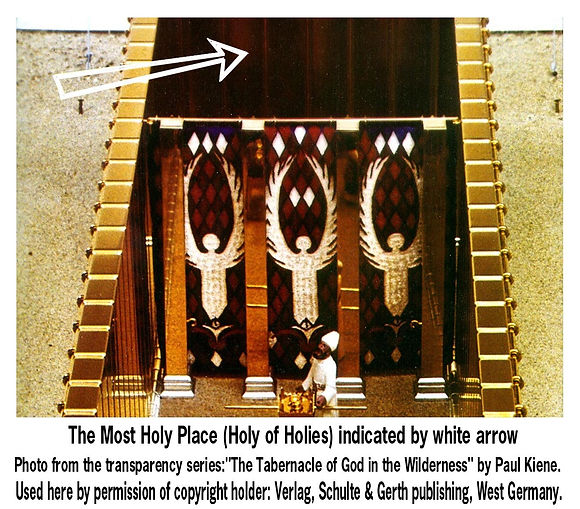
The curtain or veil, as it is often called, was hung on four acacia posts covered with gold set in silver bases dividing the interior of the Tent of Meeting into two compartments; the Holy Place and the Most Holy Place (Holy of Holies).
The Holy Place, located at the east end, was approximately two times the size of the Most Holy Place. The Most Holy Place was behind the curtain at the west end at the back of the tent.
The Holy Place
The Holy Place photo from the transparency series, "The Tabernacle of God in the Wilderness" by Paul Kiene. Used here with the permission of Verlag, Shulte and Gerth publishing, West Germany.
The Holy Place was twenty cubits long, ten cubits high and had an outside width of eight frames or twelve cubits (see west of Most Holy Place). This gave it and inside width, allowing for the thickness of the walls, of ten cubits.. The Holy Place ten cubits high, ten cubits wide and twenty cubits (approx. fifteen feet wide by fifteen feet high by thirty feet long), was twice as large as the Most Holy place.
Ten, as we’ve seen, is the number of law, order, trial and testing eight is symbolic of resurrection and a new beginning, twelve is symbolic of divine government and twenty is the age at which young Israelite men became countable in the census and the number symbolizing submission to God's will.
Therefore, in these combinations we find law, order, trial and testing; also sufficiency completeness, wholeness and enough plus resurrection and new beginning; and finally we see service and submission to God's will. Coincidence? Not likely!
This room of the Tent of Meeting was located on the east end where the only entrance to the tent was located. Upon entering, one would see the Table of Showbread on the right and the Lampstand on the left. Directly ahead, against the Veil (dividing curtain), was the Altar of Incense.
This view had to be impressive. Overhead the white linen, beautifully woven with cherubim in scarlet, blue, and purple. To the left and right, walls of gold set in a foundation of silver. Straight ahead hung a veil of white linen woven with cherubim in scarlet, blue and purple. This was in sharp contrast to the view from outside. The outside of the Tent of Meeting was rather drab, as we’ve seen.
The white linen fences while not unattractive were hardly beautiful. The inner courtyard contained the Altar and Laver but there was nothing especially attractive or spectacular about a bronze altar containing fire and covered with fresh and dried blood or a bronze basin full of water.
The only truly beautiful thing in the Courtyard was the gate which beckoned all who would come. Here, however, as the priests entered the holy sanctuary of God, the beauty must have been striking. This is the way it is with the things of God. It is only as we get closer to God that we can appreciate the beauty, benefits and importance of being there.
The Most Holy Place (Holy of Holies)
The Most Holy Place or Holy of Holies, as it is often called, had a ceiling ten cubits high, a west wall twelve cubits wide, and was ten cubits long. The thickness of the north and south walls probably reduced the interior width of the west wall to ten cubits making the room ten cubits x ten cubits x ten cubits. A cubit was approximately eighteen inches. A rather small room for the earthly residence of Almighty God.
The west wall consisted of six frames (6 x 1.5 cubits = 9 cubits) plus two frames (2 x 1.5 cubits = 3 cubits) at the corners, that is eight frames in all fitted into sixteen silver bases. Eight frames at 1.5 cubits each = twelve cubits. The separating curtain (veil) was set about ten cubits east of the west wall.
NOTE: I believe that the second board of the double corner frames was positioned so that it was not visible from the inside and did not affect the inside dimensions.
As mentioned above six is the number of man, eight is the number of resurrection and new beginning, ten is the number of law, order, trial and testing and twelve is the number signifying divine government. The west wall, which controlled the width of the building, was comprised of six regular frames, plus a double frame unit at each of the two corners. The double frames of the corners were fitted into a ring so that the two were as one symbolizing witness and unity.
The positioning of the frames for the corners carries a unique message. Scripture mentions six frames of the west wall. Six frames of 1.5 cubits each in width = 9 cubits. The one frame visible at each of the two corners of the west wall brought the total visible frames of the west wall to eight. Eight frames times 1.5 cubits = 12 cubits. The corner frames, however, were each double frames, that is two frames bound together by bands (rings) into one unit.
There were therefore, two frames at each corner, one visible from the inside and one not visible from inside. If we add the two corner frames that were not visible the total frames of the west wall is ten. Six is the number of mankind. Eight is the number of resurrection and new beginning. Nine is the number of chaos and rebellion. Ten as we have noted is the number symbolizing law, order, government, testing and God’s holy portion. Twelve is the number of divine authority and leadership.
The shape and size of this room would seem to imply the promises that the rebellion of mankind will be brought under the the divine authority of God, and of resurrection and a new beginning for God's holy portion under perfect law and order after completion of the trial and testing. This will be brought about by the grace of God through the witness of Christ the one begotten Son of God.
The Most Holy Place contained only one article, the Ark of the Covenant with its Mercy Seat. Only the High Priest was permitted to enter the Most Holy Place and even he could enter only one time each year to make atonement for the sins of the people. But he first had to make atonement for his own sin. When he entered, he had to bring incense and the blood of a sacrifice with him (Leviticus 16:2-15 and Exodus 30:9-10). The priest would enter the tent through the only entrance at the east-end. The first room he entered was the Holy Place. To enter the Most Holy Place he would walk to the west-end of the Holy Place and go behind the veil dividing the two rooms.
Entrance of the Tent of Meeting
The Command:
Ex. 26:36 For the entrance to the tent make a curtain of blue, purple and scarlet yarn and finely twisted linen-- the work of an embroiderer.
Ex. 26:37 Make gold hooks for this curtain and five posts of acacia wood overlaid with gold. And cast five bronze bases for them. NIV (Italics mine).
The Materials and Design of the Entrance
This was the only attractive part of the tent visible from the outside. The entrance to the Tent of Meeting was a curtain of blue, purple and scarlet yarn and finely twisted linen hung on five acacia posts (pillars) with hooks. There is remarkable similarity to the gate of the fence.
However, while the courtyard tells us something of God’s love, holiness, power, grace and purity, nothing has yet revealed His glory. Here at the entrance of the Tent of Meeting we get our first hint of what lies inside the dwelling of God. The tops of the posts and their hooks were overlaid with gold representing the kingship, deity and glory of Jesus. The posts were set in bronze bases (Exodus 36:37-38). The bronze bases indicate His authority to judge (Matthew 28:18) .
The curtain of white linen with blue, purple and scarlet symbolized Jesus purity, heavenly origin, royalty and sacrifice. Therefore, going through the curtain symbolized passing into Jesus.
It is significant that the entrance was as wide, ten cubits (interior width), and as high, ten cubits (15 feet), as the Tent of Meeting itself. This made it half as wide and twice as high as the gate of the courtyard. By implication fewer would enter, "For many are invited, but few are chosen" (Matthew 22:14 KJV)(italics mine), but those who do, enter into a higher calling and service.
The Purpose and Message of the Entrance
The Tabernacle, and especially the Tent of Meeting and its contents, was extremely important to the Israelites. David said in Psalms 27:
One thing I ask of the Lord, this is what I seek: that I may dwell in the house of the Lord all the days of my life, to gaze upon the beauty of the Lord and to seek him in his temple. For in the day of trouble he will keep me safe in his dwelling; he will hide me in the shelter of his tabernacle and set me high upon a rock. Psalms 27:4-5 NIV (italics mine).
The curtain of the entrance to the courtyard, hanging on four posts with silver caps, speak to us of the four gospels and the Lord’s purity, heavenly origin, royalty, and sacrifice which is the message of the four Gospels. This curtain at the entrance to the Tent of Meeting hangs on five acacia wood pillars in bases of bronze with gold caps.
The acacia wood speaks of the Lord’s sinless humanity while the caps and bands of gold speak of His glory. The number five symbolizes God’s grace and man’s responsibility. The Lord is full of grace and very willing to forgive our sin when we humble ourselves and repent. Once forgiven, we have a responsibility to bear witness, by word and deed, to what the Lord has done for us. The gate of the courtyard beckoned to all who would come.
This entrance to the Tent of Meeting, however, was only for the priests. Even other Levites were not permitted inside the Tent of Meeting while the holy articles were uncovered and open to view (Num. 4:1-20).
It is significant that all the rest of the boards and posts of the Tent of Meeting were set in silver but the five posts of the entrance were set in bronze. Bronze implies judgment as discussed previously. In our discussion of the Laver it was mentioned that the priests were required to wash their hands and feet, each time, prior to entering the tent. This was symbolic of cleansing by the Word of God, through self- judgment, under the inspiration of the Holy Spirit.
But if we judged ourselves, we would not come under judgment. 1Corinthians 11:31 NIV (italics mine).
To be prepared for ministry we must be willing to judge sin in ourselves by the Word of God under the convicting power of the Holy Spirit. Jesus prayed just before He was arrested, "Sanctify them by the truth; your word is truth." John 17:17 NIV (italics mine).
Webster’s New World Dictionary defines sanctify as follows:
1. to make holy; specif., a) to set apart as holy; consecrate b) to make free from sin; purify 2. to make binding or inviolable by religious sanction 3. to make productive of spiritual blessing.
God also said:
"This is the covenant I will make with the house of Israel after that time, declares the Lord. I will put my laws in their minds and write them on their hearts." Hebrews 8:10 NIV (italics mine).
To enter the Tent of Meeting without this washing would have meant immediate death to the offending priest.
"-- they shall wash their hands and feet so that they will not die. This is to be a lasting ordinance for Aaron and his descendants for the generations to come." Exodus 30:21 NIV (italics mine).
The message is clear that this is a serious matter in God’s eyes. The holy things of God are not to be treated as common. Everyone, who came to worship, and make an appropriate sacrifice, could enter the gate of the courtyard. It was not so with the entrance to the Tent of Meeting. Only the priests could enter it.
"For many are invited but few are chosen." Matthew 22:14 NIV (italics mine).
One must enter God's presence with an attitude of reverence and only after having been cleansed of the filth of this world. The holy and intimate things of God are not for everyone. Most cannot, or will not, properly value and appreciate them. The priest had to be chosen by God, washed, dressed, and anointed with oil. They then had to offer appropriate sacrifices and wash at the laver prior to entering. In short, the priest had to be chosen, cleansed, prepared and empowered to serve in ministry for the Lord. If any of these were omitted, or lacking, he would surely die (see: Exodus 30: 20-21).
To enter the dwelling place of Holy God is a serious matter -- not to be treated carelessly or lightly. We will touch more deeply on this matter of treating holy things as common later (also see:Appendix #4 Separation of the Holy From the Common).
The Foundation of the Building
The Command:
Ex. 26:19 and make forty silver bases to go under them-- two bases for each frame, one under each projection.
Ex. 26:20 For the other side, the north side of the tabernacle, make twenty frames Ex. 26:21 and forty silver bases -- two under each frame.
Ex. 26:22 Make six frames for the far end, that is, the west end of the tabernacle, Ex. 26:23 and make two frames for the corners at the far end.
Ex. 26:24 At these two corners they must be double from the bottom all the way to the top, and fitted into a single ring; both shall be like that.
Ex. 26:25 So there will be eight frames and sixteen silver bases-- two under each frame. NIV (italics mine).
.
Ex. 30:11 Then the LORD said to Moses,
Ex. 30:12 When you take a census of the Israelites to count them, each one must pay the LORD a ransom for his life at the time he is counted. Then no plague will come on them when you number them.
Ex. 30:13 Each one who crosses over to those already counted is to give a half shekel, according to the sanctuary shekel, which weighs twenty gerahs. This half shekel is an offering to the LORD.
Ex. 30:14 All who cross over, those twenty years old or more, are to give an offering to the LORD.
Ex. 30:15 The rich are not to give more than a half shekel and the poor are not to give less when you make the offering to the LORD to atone for your lives. NIV (italics mine).
The foundation of the Tent of Meeting was very unique. It was made up of blocks of silver, two under each frame of the north, south and west walls and one block under each of the four posts supporting the shielding curtain separating the Holy Place form the Most holy Place. The only exception was the east-end where the colorful curtain that covered the entrance hung on posts set in bronze bases.
The Materials of the Foundation
Ex. 30:16 Receive the atonement money from the Israelites and use it for the service of the Tent of Meeting. It will be a memorial for the Israelites before the LORD, making atonement for your lives. NIV (italics mine).
.
Ex. 38:25 The silver obtained from those of the community who were counted in the census was 100 talents and 1,775 shekels, according to the sanctuary shekel-- Ex. 38:26 one beka per person, that is, half a shekel, according to the sanctuary shekel, from everyone who had crossed over to those counted, twenty years old or more, a total of 603,550 men.
Ex. 38:27 The 100 talents of silver were used to cast the bases for the sanctuary and for the curtain -- 100 bases from the 100 talents, one talent for each base. NIV (italics mine).
The foundation of the Tent of Meeting was made of one hundred talents (about 7,500 pounds) of pure silver. There were one hundred bases of one talent each. Never has any building had a more costly foundation. Every frame (board) and all of the posts holding the veil were set in sockets (bases) of pure silver - one talent (approx. 75 pounds) of silver per base and two bases under each board. As mention previously, only the bases supporting the five posts supporting the curtain at the entrance to the tent were of bronze.
The Source of the Materials
Ex. 30:11 Then the LORD said to Moses,
Ex. 30:12 When you take a census of the Israelites to count them, each one must pay the LORD a ransom for his life at the time he is counted. Then no plague will come on them when you number them.
Ex. 30:13 Each one who crosses over to those already counted is to give a half shekel, according to the sanctuary shekel, which weighs twenty gerahs. This half shekel is an offering to the LORD.
Ex. 30:14 All who cross over, those twenty years old or more, are to give an offering to the LORD.
Ex. 30:15 The rich are not to give more than a half shekel and the poor are not to give less when you make the offering to the LORD to atone for your lives.
.
Ex. 38:25 The silver obtained from those of the community who were counted in the census was 100 talents and 1,775 shekels, according to the sanctuary shekel-- Ex. 38:26 one beka per person, that is, half a shekel, according to the sanctuary shekel, from everyone who had crossed over to those counted, twenty years old or more, a total of 603,550 men.
Ex. 38:27 The 100 talents of silver were used to cast the bases for the sanctuary and for the curtain-- 100 bases from the 100 talents, one talent for each base. NIV (italics mine).
Especially noteworthy is the fact that the silver, unlike the bronze, gold and other materials, was not a freewill offering. The giving of this silver by the Israelites was not optional.
"When you take a census of the Israelites to count them, each one must pay the LORD a ransom for his life at the time he is counted. Then no plague will come on them when you number them." Exodus 30:12 NIV (italics mine).
There were dire consequences for failing to give the price of atonement when the census was taken. David learned this lesson the hard way many years later when he arrogantly decided to take a census of Israel without collecting the required atonement (ransom) from each man counted (2 Samuel 24:1-25).
Being counted as a citizen of Israel was symbolically like being counted as part of God’s eternal kingdom. He would not permit anyone to be counted among His people without the proper atonement price. It would be as if God were saying that sinners may enter heaven without atonement for their sins. God declared in the beginning that there would be a penalty for sin (Gen. 2:16-17). God will not permit anyone to enter without the atoning blood of Jesus no matter who thinks otherwise.
The Purpose and Message of the Foundation
This foundation like any other was to support the building and provide the structural support to make the building sound. It is obvious, however. that the sockets of this structure did not have to be made of silver to provide the structural support necessary to hold up a few boards and some linen and skin coverings.
Why use pure silver? The answer is in the symbolic meaning of silver in the scriptures. The price "blood money" (Matthew 27:3-6) paid for Judas Iscariot’s betrayal of Jesus was thirty pieces of silver (Matthew 26:14-15). In the command given to Moses by God we see that each man 20 years old and upward was to pay a ransom to the Lord for his soul of a half a shekel of silver,
"-- when you make the offering to the LORD to atone for your lives."
The price of atonement, one half shekel was equal to ten gerahs. This was a very small price, equal to less than 1/5th of an ounce of silver. This was a price anyone could easily afford, especially after the rich gifts they received from the Egyptians, but it was sufficient to please God because it displayed faith and obedience.
Notice here that the price was equivalent to ten gerahs. Ten in scripture is symbolic of law, order, and government and also trial, testing and personal responsibility (see: Appendix 3, Numerical Symbols). With God, the issue was not how much ransom was paid. It was whether His people would believe Him and be obedient and pay the price He required. That is still the issue!
This was the silver used in the foundation sockets. The imagery here is very clear. The ransom for every soul is the blood of Jesus and His blood is the foundation upon which the church is built. Jesus has been variously described in scripture as the Chief Cornerstone and the Rock. He told a parable about the wise man who built his house upon a rock.
Builders of Jesus day always set a corner stone to start the foundation of their buildings. God’s plan for mankind’s redemption rests entirely upon the sacrificial blood of Jesus Christ, the Chief Cornerstone of God’s plan of redemption:
Consequently, you are now no longer foreigners and aliens, but fellow citizens; with God's people and members of God's household, built on the foundation of the apostles and prophets, with Christ Jesus himself as the chief cornerstone. In him the whole building is joined together and rises to become a holy temple in the Lord. And in him you too are being built together to become a dwelling in which God lives by his Spirit. Ephesians 2:19-22 NIV (italics mine).
And in Zechariah 10:4;
From Judah will come the cornerstone, from him the tent peg, from him the battle bow, from him every ruler. NIV (italics mine).
The Apostle Paul wrote:
By the grace that God has given me, I laid a foundation as an expert builder, and someone else is building on it. But each one should be careful how he builds. For no one can lay any foundation other than the one already laid, which is Jesus Christ. I Corinthians 3:10-11 NIV (bold and italics mine).
Jesus is the sure foundation for the life of every believer, for the true church (all true believers) and the foundation of God's plan of redemption.
"See, I lay a stone in Zion, a tested stone, a precious cornerstone for a sure foundation; the one who trusts will never be dismayed.--." Isaiah 28:16 NIV (bold and italics mine).
There is no other foundation and there is no other way to God. There were exactly one hundred of these silver foundation blocks. One hundred is the number indicating perfect (completed) law, order and government after trial, testing and sacrifice (see: Numerical Symbols Appendix 3) .




The Walls of the (building) Tent of Meeting
The Command:
Ex. 26:15 Make upright frames of acacia wood for the tabernacle.
Ex. 26:16 Each frame is to be ten cubits long and a cubit and a half wide,
Ex. 26:17 with two projections set parallel to each other. Make all the frames of the tabernacle in this way.
Ex. 26:18 Make twenty frames for the south side of the tabernacle.
Ex. 26:19 and make forty silver bases to go under them -- two bases for each frame, one under each projection.
Ex. 26:20 For the other side, the north side of the tabernacle, make twenty frames
Ex. 26:21 and forty silver bases -- two under each frame.
Ex. 26:22 Make six frames for the far end, that is, the west-end of the tabernacle,
Ex. 26:23 and make two frames for the corners at the far end.
Ex. 26:24 At these two corners they must be double from the bottom all the way to the top, and fitted into a single ring; both shall be like that.
Ex. 26:25 So there will be eight frames and sixteen silver bases -- two under each frame.
Ex. 26:26 Also make crossbars of acacia wood: five for the frames on one side of the tabernacle,
Ex. 26:27 five for those on the other side, and five for the frames on the west, at the far end of the tabernacle.
Ex. 26:28 The center crossbar is to extend form end to end at the middle of the frames.
Ex. 26:29 Overlay the frames with gold and make gold rings to hold the crossbars. Also overlay the crossbars with gold.
Ex. 26:30 Set up the tabernacle according to the plan shown you on the mountain. NIV (italics mine).
The north, south and west walls of the Tent of Meeting were comprised of forty six boards (frames) plus two double frames at each corner of the west wall brought the total to fifty. Each board (frame) was twenty seven inches wide (1 1/2 cubits x 18") and fifteen feet tall (10 cubits x 18"). Each double corner frames were secured with rings so that the two frames became like one very heavy board.
The boards for each of the wall units were secured to all of the other boards in the wall unit by five rods. These walls rested upon and were secured into one hundred bases of pure silver - two bases under each frame.
Source of the Materials
The Command:
Ex 25:1 The Lord said to Moses,
Ex 25:2 "Tell the Israelites to bring me an offering. You are to receive the offering for me from each man whose heart prompts him to give.
Ex 25:3 These are the offerings you are to receive from them; gold, silver and bronze; NIV (italics mine).
Ex 25:5 rams skins died red and (italics mine).hide of sea cows; acacia wood; NIV (italics mine).
Ex 25:8 Then have them make a sanctuary for me, and I will dwell among them.
Ex 25:9 Make this tabernacle and all its furnishings exactly like the pattern I will show you. NIV (italics mine).
This was to be a freewill offering. This was not a tithe that God required as His right or His portion but rather something to be given out of love for Him as each man's heart prompted him. No pressure was to be applied. Each man was to give only if, and only as much, as he wished to. God greatly desires our love and He goes to great lengths to win it. Nevertheless, God never tries to force anyone to love Him, nor does He compel us to express our love for Him.
The Size, Materials and Design of the Boards
The Command:
Ex. 26:16 Each frame is to be ten cubits long and a cubit and a half wide,
Ex. 26:17 with two projections set parallel to each other. Make all the frames of the tabernacle in this way.
Ex 26:18 Make twenty frames for the south side of the tabernacle.
Ex 26:19 and make forty silver bases to go under them -- two bases for each frame, one under each projection. NIV (italics mine).
.
Ex 26:29 Overlay the frames with gold and make gold rings to hold the crossbars. Also overlay the crossbars with gold . NIV (Italics mine).
The walls of the Tent of Meeting were constructed of boards of acacia wood. These boards, referred to above as frames, formed three of the walls; the north, south and west walls, of the Tent of Meeting. The east end was the entrance and was covered only by a curtain. Each frame was one and and one-half cubits (27 inches) wide, and ten cubits (15 feet) tall, overlaid with gold. On the outside each board had rings to receive rods that tied the boards together forming a wall. At their base each board had two tenons (protuberances) cut to fit into the silver bases.
The Hebrew word translated tenons in the KJV is yawd and means:
OT:3027 yad (yawd ); a primitive word; a hand (the open one [indicating power, means, direction, etc.], in distinction from OT:3709, the closed one);
(Biblesoft's New Exhaustive Strong's Numbers and Concordance with Expanded Greek-Hebrew Dictionary. Copyright © 1994, 2003 Biblesoft, Inc. and International Bible Translators, Inc.)
We see then that this primative word yawd refers to the hand, specifically open hand, implying power, direction, the means, etc.. A closed fist would have implied harsh, even brutal punishment and forced compliance.
The open hand, by contrast, implies gentler discipline where necessary but also gentle guidance, provision, helpfulness, comfort, beckoning and protection. These hands (tenons) secured the boards in the sockets of the silver foundation bases.
The Crossbars (Rods) Their Placement and Their Message
The Command:
Ex 26:26 Also make crossbars of acacia wood: five for the frames on one side of the tabernacle,
Ex 26:27 five for those on the other side, and five for the frames on the west, at the far end of the tabernacle.
Ex 26:28 The center crossbar is to extend from end to end at the middle of the frames.
Ex 26:29 Overlay the frames with gold and make gold rings to hold the crossbars. Also overlay the crossbars with gold. NIV (Italics mine).
Each of the three walls, north, south and west had five rods overlaid with gold that were used to tie the individual boards (frames) into a single unit (wall). One of the five rods ran through the center for the entire length of each wall. This was a distance of eight cubits (12 feet)for the west wall and thirty cubits (45 feet) each for the north and south walls.
There has been some debate whether these long rods ran through holes drilled through the center of each board or through gold rings on the outside like the other four rods on each wall. My own belief, based upon scripture, investigation and logic is that the center rod ran through holes drilled from side to side through the center of each board (frame).
And the middle bar in the midst of the boards shall reach from end to end. Exodus 26:28 KJV (italics mine).
The Hebrew word translated midst (KJV) and middle (NIV) is tavek pronounced taw' - vek. The New Strong's Exhaustive Concordance defines tavek as follows:
tavek, taw;-vek; from and unused root meaning to sever; a bisection, i.e. (by implication) the centre; -- among (emphasis mine). Another rendering of tavek is through.
As mentioned previously, logic also seems to favor the middle bar running through the center of the boards. This would add greater stability to the walls and would explain the special attention given to the center bar in Exodus 26:28 (above). If this rendering is correct the message of the rods would seem to be:
4 exterior rods ---- strength to protect from the world
1 rod through the center ---- Jesus in the hearts of believers providing strength, security and stability
5 rods together ----- God's grace and man's responsibility
The Purpose and Message of the Walls
We see that the boards forming the walls, referred to as frames in some translations, were made of acacia (shittim) wood overlaid with gold. We have already seen that wood symbolizes humanity and acacia, incorruptible wood, symbolizes incorruptible humanity.
In this case we see the wood overlaid with gold, symbolizing God's glory, which speaks of incorruptible humanity clothed with God's glory (see:Appendix 2). Jesus lived in the world, and carried His message of hope to the world yet He was never contaminated by it. Jesus did not glorify Himself when He walked the earth as the suffering servant but, after His death on the cross, He assumed His rightful place at the right hand of the Father.
Christ Jesus, who died -- more than that, who was raised to life -- is at the right hand of God and is also interceding for us (Romans 8:34 NIV) (Italics mine).
Originally these boards were part of trees deeply rooted in the earth. To be fitted for their place in the Tabernacle they had to be cut down, pruned, shaped, dried out, and ultimately overlaid with gold. This is the very image of Jesus Christ. He is referred to as the Root of Jesse in Isaiah 11:10; and as the Branch of the Lord in Isaiah 4:2; Jeremiah 23:5; and Zechariah 3:8).
Isaiah spoke prophetically of Jesus saying:
"-- For he was cut off from the land of the living;" Isaiah 53:8 NIV (italics mine).
and Daniel wrote:
After the sixty-two sevens, the Anointed One will be cut off and will have nothing." Daniel 9:26 NIV (italics mine).
Through Mary, Jesus had roots in the earth as men do, however, through God, He had divine Spirit and was able to live without sin. In Hebrews 5:8 we learn:
Although he was a son, he learned obedience through what he suffered and, once made perfect, he became the source of eternal salvation for all who obey him and was designated by God to be high priest after the order of Melchizedek. NIV (Italics mine).
Although Jesus was absolutely sinless He was made perfect, that is complete or ready to assume His role as Savior, High Priest and Intercessor. This statement may be confusing to some. It is, I believe, simply a statement saying that it was necessary for God to stoop to the level of men; suffer temptations, pain, and death as men do, for us to accept by faith that He cares and has provided a means of redemption for us.
It was not sufficient for Jesus to take human form and live a sinless life. That would keep Him pure and sinless but it would not pay the awful price of sin for us, "for the wages of sin is death," (Ro. 6:23 NIV italics mine) neither would it have given us a High Priest to intercede for us who we could trust to understand our infirmities.
Thirty pieces of silver were paid as blood money for Jesus because silver symbolizes Jesus blood and the thirty pieces symbolize His readiness to be our High Priest. This became the symbolic price for the martyred faithful followers of Jesus who would come later.
So we see Jesus was trimmed and shaped by temptations, trials and suffering. Finally He was cut down to be used in His proper place. Through His suffering and death in the process of obeying God, Jesus gained unique understanding of our difficulties in obeying as we struggle through our trials and tribulations. That understanding increases our confidence in His qualifications to be both our High Priest and our Judge. As our High Priest He guides and instructs us through the Holy Spirit and constantly intercedes for us with the Father.
The day will come, however, when all will face judgment. His followers, saved by their faith, will be judged on the basis of their works to determine their reward. The unfaithful and unbelievers will be judged to determine their punishment.
We who are to reflect His image likewise are called to be pruned, shaped and fitted through suffering to take our proper place. We are like the acacia trees of the Tabernacle. Originally we had our roots deeply sunk into this world and we thirstily drank in all that it offered. To be fitted for God's Tabernacle we had to be:
-
cut down; crucified with Christ -- made dead to this world (Romans 6:6-8),
-
pruned and dried out by suffering trials, tribulations and discipline ( 1 Peter 4:12-13),
-
shaped and fitted through sanctification (James 2:14-17) , and finally
-
covered with the gold of God's ordination we can be placed into service.
The Apostle Paul wrote:
Don't you know that you yourselves are God's temple and that God's Spirit lives in you? If anyone destroys God's temple, God will destroy him; God's temple is sacred, and you are that temple. 1 Corinthians 3:16 NIV (italics mine).
Do you not know that your body is the temple of the Holy Spirit, who is in you, whom you have received from God? 1 Corinthians 6:19 NIV (italics mine).
The tenons (hands) of these boards forming the walls were anchored into sockets (holes) in the silver bases locking them tightly into the foundation. They were then further fastened into their place by the rods.
Four rods ran through rings on the exterior of the boards and a fifth ran through the heart of each of the boards from one end of the wall to the other securing them firmly into a unit.
This presents a beautiful picture of Christ and the church members. Each member is anchored in Christ as the foundation and they are locked firmly into one unit by the four rods on the exterior. These four rods represent the four gospels presented to the world which carry the truth unifying believers into a strong protective wall against the deception and corruption of the world. The fifth rod, Jesus, the messenger and embodiment of God's grace, is in the heart of each believer uniting them as one body to resist the storms of the world.
Without the rods locking them together as a unit the boards could easily be tipped over in spite of being anchored into the foundation sockets (blocks). We also need to be firmly secured to each other so that we will be able to stand up during the storms of life.
Churches, likewise, need each other. Standing alone the walls of the Tent of Meeting, while firmly linked into wall units by the rods and bases could not have withstood the strong winds of the desert storms. The three wall units had to be fastened to each other. Separately, they would have easily been blown over in spite of being anchored into the foundation sockets. Each wall unit needed the other two wall units for strength and stability. We also each need to be firmly secured to other believers so their witness can help us to stand up during the storms of life.
Together the five rods speak of God's grace -- the grace by which He planned and provided for our salvation and security and of our responsibility to study God's word by which we are sanctified and unified to resist the storms of life.
When the trees were cut down, trimmed, dried out and cut into boards they could not be replanted into the earth, they no longer belonged there. They had to either be shaped and fitted for use in the Tabernacle or cast aside as trash. So it is for those who come to the Lord then long for the world they left. They no longer belong to, or really fit in the world. They can't ever really thrive there having already been changed.
But some resist being prepared for their proper place in the kingdom. God is patient and full of grace but, if they will not submit to the process of shaping and fitting to fit into their proper place, they will eventually be cast aside.
"If anyone does not remain in me he is like a branch that is thrown away and withers; such branches are picked up, thrown into the fire and burned. " John 15:6 NIV (italics mine).
For those who will submit to the chastising and disciplining necessary to prepare us for our place in God's kingdom there is great reward. Just as the boards that could be shaped and fitted were covered with gold, so those believers who willingly submit themselves to God's pruning and shaping through trials and tribulations, and endure to the end, will be clothed in glory.
"He who overcomes will, like them, be dressed in white." Revelation 3:5 NIV (italics mine).

The Curtain (Veil)
The Command:
Ex 26:31 Make a curtain of blue, purple and scarlet yarn and finely twisted linen, with cherubim worked into it by a skilled craftsman.
Ex 26:32 Hang it with gold hooks on four posts of acacia wood overlaid with gold and standing on four silver bases.
Ex 26:33 Hang the curtain from the clasps and place the ark of the Testimony behind the curtain. The curtain will separate the Holy Place from the Most Holy Place. NIV (italics mine).
The Materials and Design of the Curtain (veil)
Make a curtain of blue, purple and scarlet yarn and finely twisted linen, with cherubim worked into it by a skilled craftsman. Exodus 26:31 NIV (italics mine).
The veil was made of white linen embroidered with purple, scarlet and blue creating a pattern with cherubim. The colors of the veil, of course, speak symbolically of Jesus heavenly origin, His sacrifice and His royalty. In his book, "The Tabernacle" M.R.DeHann writes:
Rabbinical writers tell us that the veil was so firmly woven that two teams of oxen pulling in opposite directions, with the veil between them, could not tear it apart. Neither could the veil be repaired, for it was rent by God's hand, from heaven. Tradition also tells us that the priests tried to mend and sew the veil together again, but were unable to, for no thread, no cord, would hold in the repaired part. It was rent once for all, and forever.
The Placement of the Curtain (veil)
Hang it with gold hooks on four posts of acacia wood overlaid with gold and standing on four silver bases. Hang the curtain from the clasps and place the ark of the Testimony behind the curtain. The curtain will separate the Holy Place from the Most Holy Place. Exodus 26:32-33 NIV (bold mine).
The veil was placed twenty cubits back from the entrance to the tent. For this reason the first room the priest entered, the Holy Place, was one and one half times as large as the Most Holy Place. Since the curtain was the full width and height of the room it was impossible for a priest to see into the Most Holy Place without passing through the veil which only the High Priest was allowed to do. Even the High Priest was only allowed into the Most Holy Place only once each year on the Day of Atonement.
The Pattern of the Curtain (veil)
We don't know exactly what the pattern of the veil was like. We know its colors from scripture. We have good reason to believe it was very beautiful since God designed it and gave the craftsmen the skills to make it:
Then the Lord said to Moses," See, I have chosen Bezalel son of Uri, the son of Hur, of the tribe of Judah, and I have filled him with the Spirit of God, with skill, ability and knowledge in all kinds of crafts -- to make artistic designs for work in gold, silver and bronze, to cut stones, to work in wood, and to engage in all kinds of craftsmanship. Moreover, I have appointed Oholiab son of Ahisamach, of the tribe of Dan, to help him. Also I have given skill to all the craftsmen to make everything I have commanded you; --" Exodus 31:1-6 NIV (italics mine).
The Cherubim
We do know from scripture that there were cherubim woven into the fabric pattern. We also know that cherubim were woven into the linen forming the inner layer of the curtains overhead and cherubim were on the Mercy Seat. So what is the significance of the cherubim?
Hear us O Shepherd of Israel, you who lead Joseph like a flock; you who sit enthroned between the cherubim, -- Psalms 82:1 NIV (italics mine).
We are first told of cherubim in the story of Adam and Eve:
So the Lord banished him (Adam) from the Garden of Eden to work the ground from which he had been taken. After he (God) drove the man out, he placed on the east side of the Garden of Eden cherubim and a flaming sword flashing back and forth to guard the way to the tree of life. Genesis 3:23-24 NIV (Italics and inserts mine).
After the Lord delivered him from Saul and his other enemies, David wrote:
He mounted the cherubim and flew; he soared on the wings of the wind. Psalms 99:1-3 NIV (italics mine).
Another Psalm says:
The Lord reigns, let the nations tremble; he sits enthroned between the cherubim, let the earth shake. Great is the Lord in Zion; he is exalted over all the nations. Let them praise your great and awsome name -- he is holy. Psalm 99:1-3 NIV (italics mine).
In Ezekiel's vision by the Kebar River he describes four living creatures:
Their faces looked like this: Each of the four had a face of a man, and on the right side each had the face of a lion, and on the left the face of an ox; each also had the face of an eagle. Such were their faces. Their wings were spread out upward; each had four wings, one touching the wing of another creature on either side, and two covering it's body. Each one went straight ahead. Wherever the spirit would go, they would go, without turning as they went. The appearance of the living creatures was like burning coals of fire or like torches. Fire moved back and forth among the creatures; it was bright and lightning flashed out of it.The creatures sped back and forth like flashes of lightning. Ezekiel 1:10-14 NIV (italics mine).
He identifies these creatures as cherubim in Ezekiel 10:15;
Then the cherubim rose upward. These were the living creatures I had seen by the Kebar River. NIV. (italics mine).
Ezekiel also referred to the cherubim as he described his vision of the Lord's glory departing from the Temple:
Then the glory of the Lord departed from the threshold of the temple and stopped above the cherubim. While I watched, the cherubim spread their wings and rose from the ground, and as they went, the wheels went with them. They stopped at the the entrance to the east gate of the Lord's house, and the glory of the God of Israel was above them. Ezekiel 10:18-19 NIV (italics mine).
We see the Lord enthroned between the cherubim, mounting them and soaring on the wind. They have the four faces; face of a lion, face of an ox, and face of an eagle; face of a man. The cherubim are also associated with fire and sword as well as the coming and going of the glory of God.
Scripture doesn't tell us exactly what or who the cherubim are. It does seem clear, however, that they are very close to God. Ezekiel said,"Wherever the spirit would go they would go, -- ." He described them as follows, "The appearance of the living creatures was like burning coals of fire are like torches." (italics mine).
When the glory of God departed from the temple he said he saw it stop, "above the cherubim" (italics mine).We know, therefore, that the cherubim work closely with the Spirit of God and apparently act as defenders of God's holiness and those things connected with His holiness.
Purpose and Message of the Curtain (veil)
The obvious purpose of the veil was to divide the Tent of Meeting into compartments. The veil separated the Tent of Meeting into two compartments with the Holy Place on the east end of the interior space and the Most Holy Place on the west end accessible only by going through the Holy Place.
"Hang the curtain from the clasps and place the ark of the Testimony behind the curtain. The curtain will separate the Holy Place from the Most Holy Place." Exodus 26:33 NIV (italics mine).
The first compartment, occupying the eastern three fifths of the tent, was called the Holy Place and was the first room one would enter when entering through the curtain from the courtyard. This room was ten cubits (15 feet) wide, ten cubits (15 feet) high, and twenty cubits (thirty feet) .
At the rear (west end) of the room was the veil that separated it from the Most Holy Place (Holy of Holies). The white linen signified Jesus purity and sinless nature, the blue His heavenly origin, the purple His royalty, and the scarlet His atoning sacrifice (Chapter 5 "Jesus the Veil"). Together they portrayed His total perfection, setting a standard no mere human could attain.
The cherubim, as discussed previously, appear to be the spiritual guardians of God's holiness and glory. It is important to note that the cherubim each had four faces; man, lion, ox, and eagle. These represent the four fold personage of Jesus;
-
the face of a man -- Son of Man,
-
the face of a lion -- Lion of Judah,
-
the face of an ox -- Suffering Servant,
-
the face of an eagle -- risen Savior with regal power and authority to protect and discipline.
This beautiful veil served as a constant reminder to those who served in the outer room that, behind this veil, within the Most Holy Place, dwelt the one and only, holy and powerful, God of Creation.
Requirements for Access to the Tent of Meeting
Although the gate of the courtyard was wide, not everyone was admitted into the courtyard. There were gatekeepers assigned to assure that only those with acceptable offerings were admitted.
So it was with the Tent of Meeting. Only those who met the requirements stipulated by God could enter.
Chosen by God
To enter the Tent of Meeting the man had to be chosen to be a priest. He had to be a descendant of Aaron.
"Have Aaron your brother brought to me from among all the Israelites, along with his sons Nadab and Abihu, Eleazar and Ithamar, so that they may serve me as priests. --" Exodus 29:1 NIV (italics mine).
The priesthood is theirs by a lasting ordinance.
In this way you shall ordain Aaron and his sons. Exodus 29:9 NIV (italics mine).
Consecrated by God
He had to be consecrated as a priest:
"This is what you are to do to consecrate them, so they may serve me as priests: -- ." Exodus 29:1 NIV (italics mine).
An offering was to be made to the Lord of one young, unblemished bull and two unblemished rams, together with; unleavened bread, cakes and wafers anointed with oil.
"This is what you are to do to consecrate them, so they may serve me as priests: Take a young bull and two rams without defect. And from fine wheat flour, without yeast, make bread , and cakes mixed with oil, and wafers spread with oil." Exodus 29:1-2 NIV (italics mine).
It is important to note that the ordination ceremony was designed to be a series of things done for and to the priest -- not things for the priest to do to or for himself. The service of the priest was to begin only after his ordination.
First, the priests were brought to the entrance to the Tent of Meeting -- into the presence of God. There they were washed with water by Moses symbolic of cleansing from sin (eventually to be permanently washed away by the blood of Jesus).
Next, they had to be clothed by Moses in priestly garments symbolizing righteousness and readiness (preparation through consecration and sanctification).
Finally, they were anointed with oil by Moses symbolizing the anointing (empowering) for ministry by the Holy Spirit.
"Then bring Aaron and his sons to the entrance to the Tent of Meeting and wash them with water. Take the garments and dress Aaron with the tunic, the robe of the ephod, the ephod itself and the breastpiece. Fasten the ephod* on him by its skillfully woven waistband. Put the turban on his head and attach the sacred diadem to the turban. Take the anointing oil and anoint him by pouring it on his head. Bring his sons and dress them in tunics and put headbands on them. Then tie sashes on Aaron and his sons. The priesthood is theirs by a lasting ordinance. In this way you shall ordain Aaron and his sons." Exodus 29:4-9 NIV (italics mine).
All of these things having been done to and for Aaron and his sons to prepare them and ordain them for priesthood they were now ready and it was time for them to start serving God and the people God had chosen.
Then the bull was brought to the tabernacle entrance, the priests were to lay hands upon it, kill it, anoint the horns of the altar with its blood and pour the remainder of the blood at the altar base.
"Bring the bull to the front of the Tent of Meeting, and Aaron and his sons shall lay their hands on its head. Slaughter it in the LORD'S presence at the entrance to the Tent of Meeting. Take some of the bull's blood and put it on the horns of the altar with your finger, and pour the rest of it at the base of the altar. " Exodus 29:10-12 NIV (italics mine).
They witnessed the sacrifice, symbolic of the lamb (Jesus) that God would someday provide, and the symbolic transferring of their sins to it. Although the sacrifice that Jesus would one day make was portrayed in their presence, it must be remembered that they did not recognize it. The concept of a suffering Messiah was, and still is, foreign to most Jews.
For centuries the hope and expectation of Jews, generally, has been for a messiah who would be a strong political figure who would deliver them from all oppression. The Lord required that the fat of the bull, the covering of the liver, the kidneys and all the fat around them be burned upon the altar.
"Then take all the fat around the inner parts, the covering of the liver, and both kidneys with the fat on them, and burn them on the altar. But burn the bull's flesh and its hide and its offal outside the camp. It is a sin offering." Ex. 29:13 NIV (italics mine).
The caul (KJV) is a membrane in the abdominal cavity that covers the liver and other organs. The fat is the most flavorful part of the flesh of the animal. Even today, though many are starting to buy leaner cuts for health reasons, the choice (prime) cuts of meat are those with the marbling of fat in them.
The kidneys are the organs that remove the impurities from the blood. The Lord was, therefore, requiring that the choicest portions be offered. This is discussed in greater detail under the headings, "Even the High Priest had to Prepare" and "Jesus: The Perfect Offering".
Ordained by God
Next one of the rams was brought and Aaron, the High Priest, and his sons were to lay hands upon its head, kill it, and sprinkle its blood around the altar.
"Take one of the rams, and Aaron and his sons shall lay their hands on its head. Slaughter it and take the blood and sprinkle it against the altar on all sides." Exodus 29:15-16 NIV (italics mine).
They were then to cut the ram into pieces, washing the inner parts and legs, and burn the entire ram, including the head upon the altar.
"Cut the ram into pieces and wash the inner parts and the legs, putting them with the head and the other pieces. Then burn the entire ram on the altar. It is a burnt offering to the LORD, a pleasing aroma, an offering made to the LORD by fire." Exodus 29:17-18 NIV (italics mine).
The other ram was then brought and Aaron (the High Priest) and his sons laid hands upon it and killed it. The blood was then applied to their right ears, right hands, and the big toe of their right foot.
The ear refers to hearing and understanding, the right hand and big toe to blessing, friendship, service, agreement, loyalty and obedience (our walk).
The blood of the ram was then sprinkled on all sides of the altar.
"Take the other ram, and Aaron and his sons shall lay their hands on its head. Slaughter it, take some of its blood and put it on the lobes of the right ears of Aaron and his sons, on the thumbs of their right hands, and on the big toes of their right feet. Then sprinkle blood against the altar on all sides." Exodus 29:19-20 NIV (italics mine).
Anointed by God
Some of the blood from the altar and the anointing oil was sprinkled upon Aaron and his sons to consecrate them and their garments.
"And take some of the blood on the altar and some of the anointing oil and sprinkle it on Aaron and his garments and on his sons and their garments. Then he and his sons and their garments will be consecrated." Exodus 29:21 NIV (italics mine).
Note that not only were Aaron and his sons anointed to consecrate them but their garments were anointed to consecrate them also. Their garments were the visible outward symbols showing that God had prepared them for, and placed them in, the priesthood. Everything about them from their hearts to their actions, especially those acts performed while wearing their priestly garments, were to be consecrated to the Lord. We, likewise, need to consecrate; ourselves, our gifts, our talents, our training, and all the symbols of whatever service that God may place us in, to His honor and glory.
Next, from this ram, the fat and right thigh, the covering of the liver, kidneys and their fat, and the right shoulder, together with; one of the loaves of unleavened bread, a cake made with oil, and a wafer, were placed in the hands of Aaron and his sons. They then waved these before the Lord as a wave offering.
"Take from this ram the fat, the fat tail, the fat around the inner parts, the covering of the liver, both kidneys with the fat on them, and the right thigh. (This is the ram for the ordination.). From the basket of bread made without yeast, which is before the LORD, take a loaf, and a cake made with oil, and a wafer. Put all these in the hands of Aaron and his sons and wave them before the LORD as a wave offering." Exodus 29:22-24 NIV (italics mine).
These were then burned on the altar as a sweet savor offering to the Lord.
"Then take them from their hands and burn them on the altar along with the burnt offering for a pleasing aroma to the LORD, an offering made to the LORD by fire." Exodus 29:25 NIV (italics mine).
The breast of the ram and the thigh that was presented before the Lord were always to be for Aaron and his descendants as their share.
"After you take the breast of the ram for Aaron's ordination, wave it before the LORD as a wave offering, and it will be your share. Consecrate those parts of the ordination ram that belong to Aaron and his sons: the breast that was waved and the thigh that was presented.This is always to be the regular share from the Israelites for Aaron and his sons. It is the contribution the Israelites are to make to the LORD from their fellowship offerings." Exodus 29:26-28 NIV. (italics & bold mine).
The flesh of the ram was to be cooked in a holy place and Aaron and his sons, no one else, were to eat it at the entrance to the Tent of Meeting.
"Take the ram for the ordination and cook the meat in a sacred place the entrance to the Tent of Meeting, Aaron and his sons are to eat the meat of the ram and the bread that is in the basket. They are to eat these offerings by which atonement was made for their ordinationand consecration. But no one else may eat them, because they are sacred. And if any of the meat of the ordination ram or any bread is left over till morning, burn it up. It must not be eaten, because it is sacred." Exodus 29:31-34 NIV (italics mine).
This, obviously, was part of the provision God made for the Isrelites to supply the needs of the priests. It also was a symbol of the way God feels about the love of His children and sacrifices they make because of their love for Him. He savors them the way the priests savored the delicious meat from these offerings.
This ordination ceremony was to last for seven days with prescribed offerings to be made each day.
"Sacrifice a bull each day as a sin offering to make atonement. Purify the altar by making atonement for it, and anoint it to consecrate it. For seven days make atonement for the altar and consecrate it. Then the altar will be most holy, and whatever touches it will be holy. This is what you are to offer on the altar regularly each day: two lambs a year old. Offer one in the morning and the other at twilight. With the first lamb offer a tenth of an ephah of fine flour mixed with a quarter of a hin of oil from pressed olives, and a quarter of a hin of wine as a drink offering. Sacrifice the other lamb at twilight with the same grain offering and its drink offering as in the morning-- a pleasing aroma, an offering made to the LORD by fire. For the generations to come this burnt offering is to be made regularly at the entrance to the Tent of Meeting before the LORD. There I will meet you and speak to you; there also I will meet with the Israelites, and the place will be consecrated by my glory." Exodus 29:36-43 NIV (italics mine).
The Lord selected the priests. They had no control over their birth and could not have chosen which tribe they would be born into. The Lord consecrated them through Moses. Moses washed them, dressed them and anointed them at the direction of the Lord.
The Lord then ordained them to minister before Himself. He appointed them to minister making sacrifices on behalf themselves, their families and the people, promising that He would provide for their needs.
Today many churches ordain men who decide that they want to become ministers for their own reasons. They don't realize that God doesn't call those who, for their own reasons want to put on the mantle of leadership. God often calls those who have no desire to receive the call, and places them into His service for His own reasons. One person, called of God to serve is worth many who try to lead by their own choice.
Even after all this preparation for service, the priests were not permitted to enter the Most Holy Place freely. In fact, no one except the High Priest could enter at all, and even the High Priest could only enter one time each year, after special preparation. The lord said to Moses:
"Tell your brother Aaron not to come whenever he chooses into the Most Holy Place behind the curtain in front of the atonement cover on the ark, or else he will die, because I appear in the cloud over the atonement cover. --" Leviticus 16:1-2 NIV (italics mine).
To enter, the High Priest had to prepare himself, make the prescribed offerings, and take some of the blood of the offering with him as he passed through the veil into the Holy of Holies (Leviticus 16:3-34). This will be discussed in greater detail later in the section entitled "Requirements for Access into The Most Holy Place."
The writer of the book of Hebrews speaks of the veil and of Jesus as follows:
Therefore, brothers, since we have confidence to enter the Most Holy Place by the blood of Jesus, by a new and living way opened for us through the curtain, that is, his body, Hebrews 10:19-20 NIV (italics & bold mine).
Now, looking back, we can easily see that the veil symbolically represented the flesh or body of Jesus. Considering the standard of sinless perfection Jesus set as He walked the earth, it is not surprising that it posed a barrier to all who might wish enter into the Most Holy Place.
This barrier remained until Jesus died upon the cross and the veil was torn, from top to bottom, opening the way to God once for all.
And when Jesus had cried out again in a loud voice, he gave up his spirit. At that moment the curtain of the temple was torn in two from top to bottom. The earth shook and the rocks split. Matthew 27:50-51 NIV (italics mine).
Now every true believer in Jesus Christ, being priests after the order of Melchizedek, have access to the throne of God.
We have this hope as an anchor for the soul, firm and secure. It enters the inner sanctuary behind the curtain, where Jesus, who went before us, has entered on our behalf. He has become a High Priest after the order of Melchizedek. Hebrews 6:19-20 NIV (italics mine).
And the Apostle Peter wrote to believers:
You are a chosen people, a royal priesthood, a holy nation, a people belonging to God, that you may declare the praises of him who called you out of darkness and into the wonderful light. 1Peter 2:9 NIV (italics mine).
We who are called of God into fellowship with Him are highly privileged. We should never forget that we are here through God's grace and mercy.
As I write this I am reminded of an event in my own family. When my youngest grandson was born it was a difficult delivery. His father, my youngest son, was stressed and so were all the grandparents. We waited for hours for some good news.
When we finally received the word that mother and son were out of delivery we could hardly bear the wait to see them. We learned that our daughter in law was fine but very tired. Our grandson, however, was in neonatal intensive care. My son got to see him right away and would give us periodic reports but we were anxious to see him for ourselves.
When we finally did get to see our new grandson we had to put on sterile surgical gowns, face masks and caps. We also had to thoroughly wash our hands with hot water and antibacterial soap. We could not risk taking dangerous germs into that sterile room with those fragile babies.
Our grandson is a fine healthy, bright twelve year old now. God has blessed us greatly. But as I look back I realize how differently things might have been if that room had not been kept sterile. It only takes one person to contaminate the environment of a sterile room. Days of cleaning and preparing can be spoiled in moments. God has shown us over and over that things that are holy and pure can become contaminated when things that are unholy and impure are brought into contact with them.
Sin is like a virus. It infects whatever it comes into contact with. We need to reverence the things of God and recognize His holiness by regularly sanctifying ourselves through self examination in the light of God's word under the guidance of the Holy Spirit lest we abuse the privilege by going into His presence unprepared.

I.The Coverings (roof) of the Tent of Meeting
The Command:
Ex 26:1 Make the tabernacle with ten curtains of finely twisted linen and blue, purple and scarlet yarn, with cherubim worked into them by a skilled craftsman. Ex 26:2 All the curtains are to be the same size-- twenty-eight cubits long and four cubits wide.
Ex 26:3 Join five of the curtains together, and do the same with the other five.
Ex 26:4 Make loops of blue material along the edge of the end curtain in one set, and do the same with the end curtain in the other set.
Ex 26:5 Make fifty loops on one curtain and fifty loops on the end curtain of the other set, with the loops opposite each other.
Ex 26:6 Then make fifty gold clasps and use them to fasten the curtains together so that the tabernacle is a unit.
Ex 26:7 Make curtains of goat hair for the tent over the tabernacle-- eleven altogether.
Ex 26:8 All eleven curtains are to be the same size-- thirty cubits long and four cubits wide.
Ex 26:9 Join five of the curtains together into one set and the other six into another set. Fold the sixth curtain double at the front of the tent.
Ex 26:10 Make fifty loops along the edge of the end curtain in one set and also along the edge of the end curtain in the other set.
Ex 26:11 Then make fifty bronze clasps and put them in the loops to fasten the tent together as a unit. Ex 26:12 As for the additional length of the tent curtains, the half curtain that is left over is to hang down at the rear of the tabernacle. Ex 26:13 The tent curtains will be a cubit longer on both sides; what is left will hang over the sides of the tabernacle so as to cover it.
Ex 26:14 Make for the tent a covering of ram skins dyed red, and over that a covering of hides of sea cows. NIV (italics mine).
The Materials and Placement of the Coverings:
There were four coverings that made up the roof of the Tent of Meeting. We will discuss them here in the order they would have been placed upon the structure as it was set up.
The first to go on was the white linen covering with its beautifully embroidered designs of cherubim in blue, scarlet and purple composed of ten curtains, each of which was four cubits (6 feet) wide and twenty-eight cubits (42 feet) long.
These were joined together to form two large curtains, in sets of five, by fifty blue loops fastened with gold clasps (see: Exodus 26:1-6) thus forming one large curtain twenty eight cubits (42 feet) wide by forty cubits (60 feet) long. The excess hung down the sides and back. This inner curtain was the only covering visible from within the tent.
Next to go on was the covering of goat hair 1 curtains. There were eleven curtains of equal size, four cubits (approx. 6 feet) wide by thirty cubits (45 feet) long joined together by loops woven into the curtains and fastened by bronze clasps into one set of five and another set of six. The extra (sixth) curtain was folded back onto the fifth at the front of the tent (Exodus 26:9 above).
The actual size of the combined sets was thirty cubits (45 feet) wide by forty-four cubits (66 feet) long. However, with the sixth curtain of the front set folded back onto the fifth the length was reduced to forty cubits (60 feet). The excess length and width of these curtains was to hang down at the sides and rear of the tent.
Notice the symbolism here all has to do with trials and testing and bringing man back to grace (sixth curtain folded back onto the fifth) to bring about self judgment and maturity for service.
Then the rams skins dyed red would go on. These clearly added strength to the roof and were protective. The message of these coverings being rams skins and being dyed red is clear. Jesus was God's perfect sacrifice for our sin. His blood paid the debt in full. He is our strength and shelter.
The last to be placed on over all the others, and therefore the only covering visible from outside the Tent of Meeting, were the hides of sea cows (badger skins in the KJV).
The reader should take notice of the fact that thirteen verses are devoted to describing the color, size, materials, number of curtains, number of hooks, etc. of the first two curtains. The Lord even gave detailed instructions for the folding back one of the goat's hair curtain. It is very significant, then, that all the instructions for the last two coverings are summed up in a single twenty-one word verse.
No details are given regarding their size or construction though they obviously had to be large enough to cover the others. The absence of details is not because they were not important. The tent would have been incomplete without them. It would not have been as secure against the elements or as structurally sound since the ropes and stakes that fastened to these helped secure everything else in place.
The description concerning these coverings was brief only because their message is so simple and direct. The ram's skin dyed red symbolized the blood sacrifice of the Lamb of God and the hides of sea cows portrayed His humility and His unpretentious and ordinary physical appearance.
The Purpose and Message of the Coverings:
The obvious benefits of the coverings were the protection from the hot sun, rain, wind, dust, cold, etc. Nevertheless, like everything else about the Tabernacle they had a higher purpose as well.
To the casual observer, the only visible covering was the one of porpoise skins (hides of sea cow). As mentioned previously this was a type of leather commonly used for shoes. A rather drab, unimpressive covering for an apparently unimpressive structure when viewed from the outside.
To the priest serving inside the Tent of Meeting the beautiful white linen with its skillfully embroidered cherubim was clearly visible as he entered. The ten curtains symbolized; law, order, government, trial and testing (see: Numerical Symbols). The white linen spoke of purity and holiness, with the blue of heaven, the purple of royalty and the crimson of sacrifice. This inner covering told of God’s deity, authority, holiness, love, provision and protection.
These curtains were held together by fifty gold hooks. The gold symbolized God's glory the number fifty speaks symbolically of freedom, liberty, and forgiveness ). God commanded that every fiftieth year was to be a year of Jubilee when debts were to be forgiven, Jews sold into servitude were to be set free and land that had been sold was to be returned to the original owners.
The goat’s hair covering spoke of the substitute sacrifice to be provided by God for the sins of mankind. They spoke of God's perfect sacrificial Lamb who; as symbolized by the scapegoat, would bear our sins.
Under Mosaic Law, one of the ceremonies involved bringing two goats before the priest. One was offered as a sacrifice. The priest then laid hands on the other one and confessed the sins of the people over it. This goat, the scapegoat, was then led far into the wilderness, and released, where it could not return to their camp (Leviticus 16:21-22). Goats were used ceremonially as sin offerings and hair in scripture symbolized a glorious, protective covering. Jesus, God's perfect sin offering, is our glorious protective covering.
This goats hair covering was made up of eleven curtains, five on one side symbolizing grace and six, the number symbolizing mankind on the other. The sixth curtain on the one side was folded back, so that there were only five showing, symbolizing man coming into God’s grace. The total of the six on the one side plus the five on the other was eleven (incompleteness and disorder), which, with the sixth curtain on the one side folded back, they became two sets of five curtains each - ten total (law, order, testing and trial). The message: God’s grace toward man will bring order out of chaos through Jesus Christ by trial and testing.
Rams, in scripture, symbolized political leadership and were used as burnt offerings. The rams skins dyed red, of course, spoke of the blood to be shed by the sacrifice God would provide. God was already looking ahead -- seeing Jesus upon the cross at Calvary. Scripture tells us that without the shedding of blood there is no atonement for sin.
At the Last Supper, before His crucifixion, Jesus offered a cup to His disciples saying:
"Drink from it all of you. This is my blood of the covenant, which is poured out for many for the forgiveness of sins." John 26:27-28 NIV (italics mine).
The rams skins dyed red covered everything in the Tent of Meeting including the linen and goats hair coverings. The only things not covered by the ram's skin covering were the outer covering of hides of sea cows (porpoise skins), the laver, the brazen altar and the fence with its gate.
The symbolic implications of this were as follows: The tents outer covering of hides of sea cows symbolized Jesus humble character and ordinary physical appearance. This humility, for the most part, was what the world saw of Jesus. Very few looked deeper to see what was inside. Only a few even saw His character although it was in plain view. This was there for all to see if they care to look. His character had no need of a blood covering because it was without flaw or imperfection, therefore, the ram's skin went under the covering of sea cow hides.
This gentle humility should cover the church - not pomp and presumptuous grandeur. Inside this humility the seeker of truth can find the light of truth, the fellowship of the Lord and the fellowship of fellow seekers, the power of prayer and the love and glory of the Lord. If the humility is lacking in the church the seeker may either be repelled completely or drawn into religious idolatry by the attraction to the material.
We saw earlier that the fence was a barrier to the courtyard. We saw that it also symbolized the spiritual barrier created by the purity, holiness and beauty of Jesus character and behavior. Again, the holiness of His character and actions needed no blood covering. The gate which shows forth some of the qualities and beauty of the Lord’s character beckons to all. No blood covering is required to receive the Lord’s welcoming call to redemption.
We discussed earlier that the symbolism of the Altar of Burnt Offering dealt with God's promise to Abraham that He, God, would provide redemption through a perfect, all sufficient, sacrificial lamb. No blood covering was necessary to receive God's promise of Jesus sacrifice.
The Laver, we've seen, symbolized God's Word in which we see our sinful reflection and the water it held symbolized the Holy Spirit who empowers and leads us through the process of repentance and sanctification. Therefore, it likewise, needed no blood covering.
The articles in the Tent of Meeting, as we shall see, symbolically related to the church, its ministries and the relationship between God and man. It is established in scripture that without the sacrifice of Jesus there would be no atonement to bridge the gulf between God and man and that the Lord's church is founded upon the blood of Christ as symbolized by the silver foundation blocks of the Tent of Meeting. It is equally well established that the church members, the real church, and their ministries are covered by the blood of Christ and are, therefore, holy. No one can approach God without the coverings provided by Jesus sacrifice.
The hides of sea cows (badger skins in KJV) spoke symbolically of the humble nature and the physical appearance of our Savior. Jesus was apparently not a physically attractive or impressive man. It was not the things people immediately saw with their eyes that attracted them to Him. This is still true today.
As mentioned above, the church, like Jesus, should present itself humbly to the people - not with glamor, glitter and pomp. It is the gospel story revealing Jesus character, love, mercy and grace impressed upon us indelibly by His selfless sacrifice as symbolized by the gate that attracts the unredeemed.
He grew up before him like a tender shoot, and like a root out of dry ground. He had no beauty or majesty to attract us to him, nothing in his appearance that we should desire him. Isaiah 53:2 NIV (italics mine).
He was despised and rejected by men, a man of sorrows, and familiar with suffering. Like one from whom men hide their faces he was despised, and we esteemed him not. Isaiah 53:3 NIV (italics mine).
But Jesus was more than just a suffering servant. He was by no means a pitiful object of abuse. While it is true that the Jewish scribes and priests plotted to kill him, and the Roman soldiers carried out their wishes, it must be remembered who Jesus was.
In the beginning was the Word, and the Word was with God, and the Word was God. He was with God in the beginning. Through him all things were made; without him nothing was made that has been made. In him was life, and that life was the light of men. John 1:1-4 NIV (italics mine).
This was Jesus - the Son of God! He was and is God. No one could take His life from Him! He was, and is, the giver of life.
"The reason that my Father loves me is that I lay down my life -- only to take it up again. No one takes it from me, but I lay it down of my own accord. I have authority to lay it down and authority to take it up again. This command I received from my Father." John 10:17-18 NIV (italics mine).
The fact that He willingly gave His life did not absolve those who plotted against Him, for by desiring His death they were already guilty.
"You have heard that it was said to the people long ago, ‘Do not murder, and anyone who murders will be subject to judgment.’ But I tell you that anyone who is angry with his brother will be subject to judgment." Matthew 5:21-22 NIV (italics mine).
Many down through the centuries have blamed the Jews for Jesus death and some blame the Romans. The truth is we are all guilty of His death for the simple reason that we are all guilty of sin and it was sin that put Jesus on the cross.
The Ropes and Stakes of the Tent of Meeting and Courtyard
The Ropes and Stakes
The Materials, Design and Placement
Ex 38:29 The bronze from the wave offering was 70 talents and 2,400 shekels. Ex 38:30 They used it to make the bases for the entrance to the Tent of Meeting, the bronze altar with its bronze grating and all its utensils,
Ex 38:31 the bases for the surrounding courtyard and those for its entrance and all the tent pegs for the tabernacle and those for the surrounding courtyard. NIV (italics mine).
The pegs or stakes used for fastening the cords or ropes to secure the Tent of Meeting were made from bronze obtained in the freewill offering made by the people to the Lord. The bronze as always was symbolic of judgment. They were, of course, pointed at one end and they were placed around the fence, inside and out to support it. They were also placed around the outside of the Tent of Meeting to support it. The stakes were driven deeply into the desert floor but the tops were left sticking out of the earth so the cords could be tied to them.
The Purpose and Message of the Ropes and Stakes
Isa 22:23 I will drive him like a peg into a firm place; he will be a seat of honor for the house of his father.
Isa 22:24 All the glory of his family will hang on him: its offspring and offshoots-- all its lesser vessels, from the bowls to all the jars.
Isa 22:25 "In that day," declares the LORD Almighty, "the peg driven into the firm place will give way; it will be sheared off and will fall, and the load hanging on it will be cut down."The LORD has spoken. NIV (italics mine).
.
Hosea 11:4 I led them with cords of human kindness, with ties of love; I lifted the yoke from their neck and bent down to feed them. NIV (italics mine).
The cords were used to fasten the posts of the fence and gate to the bronze stakes and also to secure the coverings of the Tent of Meeting with stakes surrounding it. As these things were secured with the cords and stakes so believers are held fast in the LORD with cords of love and kindness.
Isa 33:20 Look upon Zion, the city of our solemnities: thine eyes shall see Jerusalem a quiet habitation, a tabernacle that shall not be taken down; not one of the stakes thereof shall ever be removed, neither shall any of the cords thereof be broke. KJV (italics mine).
.
Zech 10:4 From Judah will come the cornerstone, from him the tent peg, from him the battle bow, from him every ruler. NIV (italics mine).
The tent pegs clearly refer to Jesus. He is the peg that was fastened in a sure place and then cut down and He is the cornerstone and the tent peg of Judah.
The ropes of the Tabernacle represented the cords of human kindness and the bands of love, by which Jesus draws us to Himself and secures us there. Men and women are not drawn to God by lofty ideals of righteousness, thoughts of heaven or even by fear of eternal damnation. They are drawn, like flies to sugar, when Jesus is lifted up and glorified in the hearts and minds of true believers as they reflect His love in their acts of kindness and charity. The greatest testimonies of Jesus love and grace are not those we speak -- they are those we illustrate by our actions!
It is interesting that tent pegs are never driven entirely into the ground. If they were they would be useless. A portion must stick up above the ground so the cords holding the tent can be fastened to them.
So it is with Jesus. If, at His death, He had not come up out of the grave His death would have paid our debt of sin, but it would have been futile since it would not have given us hope of life. We would have died free of sin, but would have had no hope of eternal life upon which to fasten our love and faith.
Category: Tabernacle
Copyright © 2011 ---.All Rights Reserved.


